
Grip Strength and Longevity: What a New 2026 Study Reveals
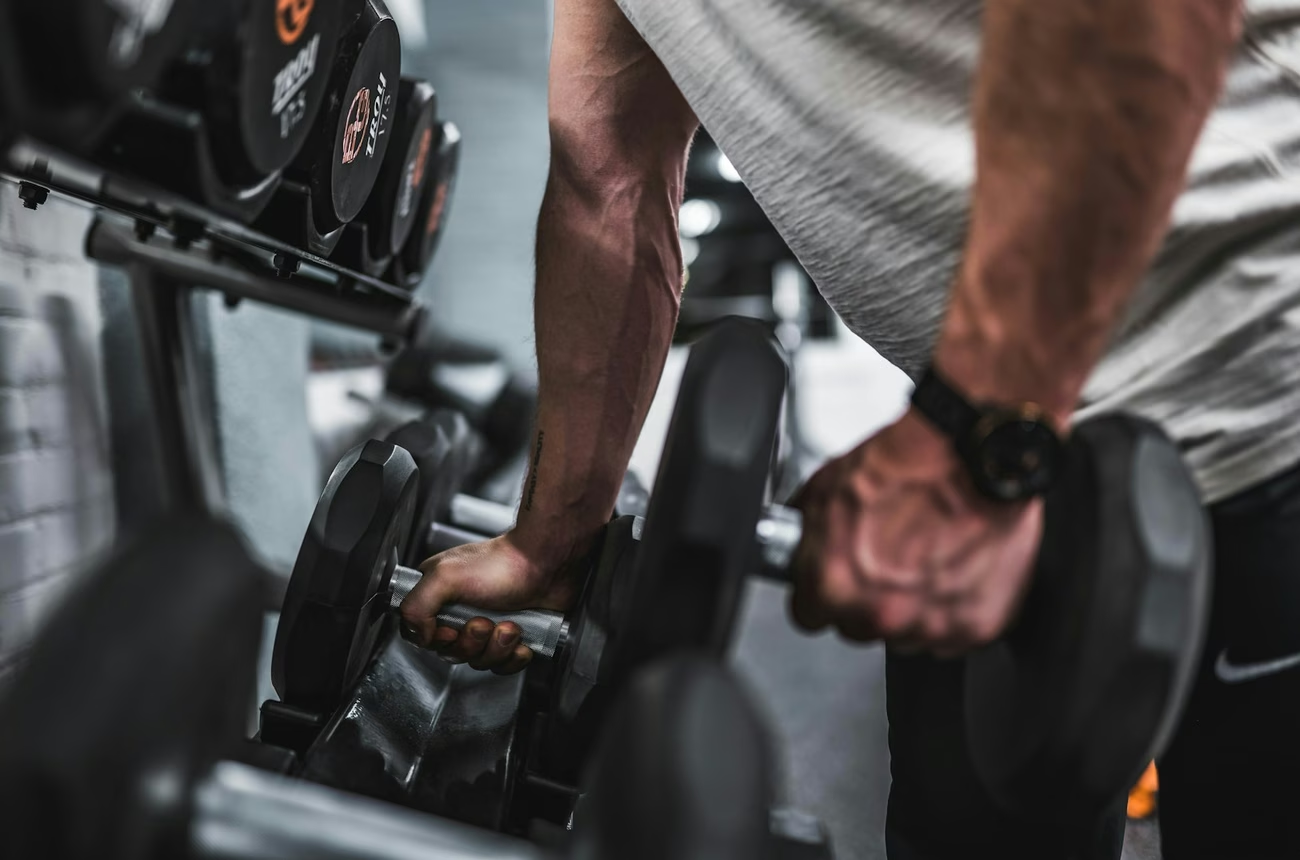
The link between grip strength and longevity just got stronger. A February 2026 study published in JAMA Network Open tracked 5,472 women aged 63 to 99 for an average of 8.4 years. Women in the highest grip strength group had a 33% lower risk of dying during the study than the weakest group, even after the researchers adjusted for age, smoking, and body weight.
The strongest women weren't gym athletes. The top group averaged about 53 pounds of grip, roughly the squeeze it takes to crush a sturdy bag of flour. The point isn't to chase a powerlifting number. It's that a simple, measurable signal, the strength of your hand, says something real about how the rest of your body is aging.
Why grip strength keeps showing up in longevity research
Grip strength isn't magic. It's a window. Researchers now describe handgrip strength as a biomarker for biological age, and one that tracks closely with overall muscle function, fall risk, bone density, and cardiovascular health.
The 2026 OPACH study isn't an outlier. A large international cohort followed nearly 140,000 adults across 17 countries and found that each 11-pound drop in grip was tied to a 16% higher risk of all-cause mortality. Harvard Health describes the muscle strength and mortality relationship as one of the most consistent findings in aging research.
Here in Charleston, that has a practical edge. Carrying groceries up porch steps, paddling on Shem Creek, opening jars, gardening, holding a leash on a long walk, all of it leans on hand and forearm strength most people never train directly.
What grip strength is actually measuring
Hand strength reflects the condition of your forearm muscles, your nervous system's ability to recruit them, and indirectly, your overall lean mass. Lean mass is everything in your body that isn't fat: muscle, bone, water, and organs. When grip drops, lean mass is usually dropping too.
What grip strength looks like by age
Grip strength peaks somewhere between the late 20s and late 30s, then declines about 1.5 kilograms (a little over 3 pounds) per decade after 40, according to normative data published in the Journal of Orthopaedic and Sports Physical Therapy. Average ranges look roughly like this:
Men
Peak around age 30 to 39 at about 100 to 110 pounds of grip (45 to 50 kilograms). By age 60 to 69, the average drops to roughly 80 to 90 pounds.
Women
Peak around age 30 to 39 at about 60 to 65 pounds (27 to 30 kilograms). By age 60 to 69, the average is around 45 to 55 pounds.
These are averages, not goals. If you're sliding faster than the curve, that gives you something concrete to work with. If you're holding steady, that's already a win.
How to test grip strength at home
The simplest tool is a hand dynamometer. Basic digital models cost $20 to $40 and give a repeatable reading. The standard protocol used in physical therapy clinics looks like this:
- Sit upright with your elbow bent at 90 degrees and your arm at your side.
- Hold the dynamometer in a neutral wrist position.
- Squeeze as hard as you can for 3 to 5 seconds.
- Record the number, rest 30 seconds, and repeat twice more per hand.
- Average the three readings.
Test once a month under similar conditions, same time of day, same posture. Daily testing is unreliable because hand fatigue varies. Track your dominant and non-dominant hands separately. It's normal for the dominant side to be about 10% stronger.
How grip fits into the bigger body composition picture
A grip test gives you one data point. A DEXA scan gives you the full muscle, fat, and bone breakdown driving that data point. If your grip is sliding faster than expected, a body composition scan helps you understand whether you're losing lean mass overall or whether the change is more localized. At our Charleston studio, clients often pair the two: monthly grip checks at home, a body composition scan every three to six months to track the trend.
How to improve grip strength after 40
Building grip is mostly about hanging onto things that are heavy, awkward, or both. You don't need specialty equipment.
Dead hangs
Hang from a pull-up bar with both hands. Start with 10 to 20 seconds and add 5 seconds a week. Two sets, two or three days per week. SilverSneakers recommends working up to a one-minute hold.
Farmer's carries
Walk 30 to 60 feet carrying a heavy object in each hand: kettlebells, dumbbells, or two reusable grocery bags loaded with canned goods. The longer the walk, the harder your grip has to work.
Towel wrings and plate pinches
Wring out a soaked dish towel as hard as you can for 30 seconds, switching directions halfway through. For pinches, hold a weight plate between your thumb and fingers as long as possible. Both train the smaller forearm muscles that get missed during standard lifts.
Aim for two or three short grip sessions per week, mixed in with regular strength work. Pair grip training with broader resistance training, since overall muscle strength drives most of the longevity signal in the research.
The bottom line on grip strength and longevity
One squeeze on a $25 device says something about your body's muscle system that would take much more to measure otherwise. The 2026 JAMA findings, paired with two decades of similar research, point at the same conclusion. Lower grip strength isn't a death sentence, and higher grip strength isn't immortality. Both are signals, and they're easier to influence than most longevity advice would suggest.
Track your grip monthly. Add hangs, carries, and pinches to your training week. If you want the full picture of what your work is actually doing to your lean mass, a body composition scan can fill that in. Share whatever you measure with your doctor or trainer so the numbers feed into decisions you're already making about training, nutrition, and overall health.
Frequently asked questions
How do you test grip strength at home?
The most reliable way is with a digital hand dynamometer, which costs $20 to $40. Sit upright, keep your elbow at 90 degrees, and squeeze the device as hard as possible for 3 to 5 seconds. Repeat three times per hand and average the readings. Test monthly under the same conditions so the results compare cleanly over time.
What is a good grip strength for my age?
For men in their 30s, average grip strength sits around 100 to 110 pounds. For women in the same age range, the average is roughly 60 to 65 pounds. Grip declines by about 3 pounds per decade after 40. The most useful number isn't a benchmark, it's your own trend line over months and years.
Why does grip strength matter for longevity?
Grip strength is one of the most consistent predictors of all-cause mortality in the research. The 2026 OPACH study found a 33% lower risk of death in the strongest women compared to the weakest. Researchers think this is because grip reflects overall muscle quality, nervous system function, and lean mass, all of which tend to decline together as you age.